Monthly Archives: January 2014

Appletreewick

It’s odd to bring up a child born in that place saying “we are not from here” but by the time I was born in Yorkshire, my parents (both southerners) had been there for years and their experience was that “others” were not easily accepted.   They made me expect not to be.  But like all children I have private memories of my childhood (as well as the shared family ones) and when I saw a new book entitled called Apple Tree Square (Louise Doughty, Faber& Faber) I saw only the first two syllables and I thought of Appletreewick.
During WWII my mother made friends with Mary and Cicely Waddington who drove the equivalent of HGVs to deliver whatever wherever, two women in men’s overalls pulled in tight at the waist, with all the trimmings – makeup, pretty hair, jewellery, high heels and perfume  – which announced unequivocally
“female and perfectly capable thank you.”   Later both married, Cicely to Jim, Mary to Walter.

I was born in 1944 as the war ended, sickly and pictures of me down the road of a lung shadow show why my parents worried.  They longed to get me away to the healing countryside, which is how I was invited to Appletreewick, where Mary and Walter lived.  I don’t remember getting there but my first sight of the original farm kitchen opens before my eyes as if it were yesterday.

property-graphics-_1092763a

It was a big square room you entered at the corner.  On the left was a window and sill sunk into a deep wall, covered with plants.  Beside this was a table and wooden chairs.  To the right was an open fire framed with a full set of kitchen regalia – trivets, hobs, hooks, bread ovens and meat ovens, beautifully blacked and in working order.  In front of this lay a red and black rag rug, reflected in the copper kettle.  A tall clocked ticked in the shadows and above my heads hung great bunches of lavender and other herbs, drying and things, wonderful things … There was a modern kitchen added at the left but I didn’t give it more than the time of day.  I remained fascinated by this room, its depth and shape and the focus of this wonderful factory of a fireplace.  Alone, I ran my hands respectfully over every bit I could reach.

Bob, World's Most Expensive Sheepdog again Comes from Skipton, U.K.

I also remember that the lavatory was an Elsan in a hut across the yard and along the field.  The paper was Izal, which never knowingly dried anything, and I had to be dissuaded from sitting on the larger of the two openings with the risk of falling in.  There was a black and white collie called Chippy round whom I wrapped my arms in the back of the old jeep when we went to Grassington or Fancarl and we hiked to the side together as we went round corners, as if in a yacht. I watched a man drink milk from a cow’s teat and when he playfully spurted me with it, I was shocked to discover it was warm.  “Blood heat,” he said knowingly.   While another man, a householder down the road whose wife ran the sub-post office, handled with wary pride a fierce pungent creature, my first ferret, and bar the red eyes, remarkably redolent of Demi Moore.
Oxford-Hip-Bath-139
Upstairs I discovered a green enamel hip bath and it was suggested that I might like my bath in it, in front of the fire.  I was seven or eight, with long coppery hair which was pinned up for me (oh the glamour) and pans of hot water were emptied unstintingly into this bath – only as an adult do I appreciate the effort.  I was transported, a queen with my own flannel and new soap.  There I sat in the warmth while the firelight flickered on the surfaces and the wind blew, Chippy sighed where he lay and the logs shifted and murmured.  For the rest of my life, luxury is an open fire in a bathroom and Appletreewick more than a small village in the Craven district of Yorkshire is an incantation to joy.

Foot Note

Sharon Stone has ugly feet.

Before you dismiss Ms. Stone as The Blonde or The Body or That Shot in Basic Instinct, see The Mighty directed by Peter Chelsom (1998).

She’s fab.  But not her feet.

She featured in a star sheet spread, usual thing, bikinis and ball gowns, but though immaculately planed and polished, the feet don’t have it.

sofia-vergara-i-was-nervous-about-working-with-sharon-stone-02

I was fascinated.  I always am by the idea that if you do enough to an unfortunate feature, it is transformed through effort.  Like men draping long hair over the bald patch.   Doesn’t work.   But I notice feet.  Prevailing fashion holds that you have to have “beach feet” all year round, that not to, is to admit you haven’t tried (reflexology, massage, foot masks, etc) while the logical extension of trying so hard is achievement.  But feet are finite.  Strip sandals are an invention of the devil and only Tamsin Outhwaite has ever had the right feet for the right shoes and vice versa so I didn’t hear a word she said (sorry).  I couldn’t take my eyes off those feet in those shoes.  It was what it was supposed to be and in the last however long that naked feet with varnished toenails in sandals exposing as much as possible (a new nudity ?) have been in fashion – from couture to the Co-op – I have only seen it work half a dozen times.  My particular recoil is saved for slightly too long nails with pearlised polish and I am nothing like a foot fetishist.  I just wouldn’t score highly in the foot beauty awards.  Mine are just humbly plain.

My first husband called them umfazi feet.  He told me it’s a Shona (Zimbabwean language) word for woman.  I was a barefoot girl and as it says in one of my books about dance, dancers’ feet bear weight and barefoot dancers’ feet are hooves.   Under pressure to modify and conform, I attacked them with hard skin remover cream, too nervous to use one of the widely offered peelers or sanders.  Better.  I slapped cream on them.  It helped.  I have wonky toenails, no polish in the world becomes them.  I tried.  Twice.  Waste of everybody’s time and effort.  Clean, neat and think about something else.  No strip sandals, hate thongs.  Broad strap across the joint, sandal attached to foot.

(Left)_(B)_Adult_foot_that_has_never_worn_shoes,_(Right)_(A)_Foot_of_a_boy_who_has_worn_shoes_for_just_a_few_weeks._Plaster_casts

25 years ago, arriving in Paris for a glamorous weekend with second husband, my left foot wasn’t comfortable.  Examination revealed something nasty in the woodshed between the smallest and the next toe.  I slipped shoes off at every opportunity and come Monday, went to see a chiropodist who reduced a soft infected corn to manageable proportions while trying to sell me on having the little toe broken and reset.  I declined.

For years the degree of discomfort caused by this small imperfection varied.  The best money I ever spent was with Bastien Gonzalez, foot man to the stars, a former skier, whose massage of the leg from knee to ankle and painstaking clean treatment of the foot really was as good as a week’s holiday.  In the sun.  And the after effects for three months.  Looked good, felt beautiful, lesion rested.

The only person who closed that lesion was Margaret Dabbs, former nurse retrained as podiatrist whose “medical pedicure” I found through The Independent.

But the product she used – an iodine based substance made for podiatrists called Ichthammol – is no longer manufactured.  And when I asked my current foot woman why, she answered “Because it is too cheap.  Not enough profit.”  I used surgical spirit every day between the toes after a shower.  Post-war child, I was used to nurses sponging their feet with it to refresh and toughen the skin.  Cleans white woodwork a treat too.

So – here’s what Santa put in my stocking.  It’s gone.   The soft corn I have had so long and whimpered over at intervals for years.  Gone.  I wear softer shoes and heaven interceded for me.

Reflexology-chart

An odd girl I once visited at a Laingian refuge said I should try and make friends with my feet.  They worked hard for me.  I took them for granted, didn’t respect them and you can’t get far without them.   At the time I thought her remarks strange but time has proved her right.

You don’t have to flash feet about but you do have to take care of them.

New Ears

We had a choir at school, first led by Mrs. Quinn and when she retired, Miss Pringle.  We sang madrigals, ballads, traditional airs and bits of classical music by, among others, Rimsky Korsakov and Mozart.

At Christmas there was a school carol service where we sang carols from all over the dominions which in the 1950s still coloured large swathes of our globes and maps the reddish pink of Empire.   The language divisions sang in French, German and Latin while the choir sang (among other things) arrangements of Benjamin Britten’s carol and The Song of the Nuns of Chester,

Music at home was dominated by all of us singing anything we could remember, usually in turn in the car, and the great bass voice of

Paul Robeson.  I had friends who studied piano and they played classical music but I had no great exposure to it other than the odd thing on the radio.  Which was just as well.  It unsettled me.

Paul_Robeson_1938

I used to say that, if you wanted to derange me, all you needed was a dark room and a set of classical recordings.  If they didn’t appeal to me, the conventions of theme and repetition set my teeth on edge.  If they moved me, they moved me so much, it was frightening.   The emotions they released were too big, great dark waves of feeling I didn’t understand.  So, for many years, I avoided classical music.

In autumn 2012, a friend asked me to go with him to a Sunday concert at the Wigmore Hall.  I hesitated but one of the great things about being older is how perceptions change, clear, alter, have different shapes like rocks emerging from water in new light.  And my friend said how much he enjoyed these concerts and he wanted to be able to share it with me.  Bless him.

It was an eye opener, with a string quartet.  We went back again some months later to hear a pianist (Itamar Golan) who changed every idea I ever had about classical piano.

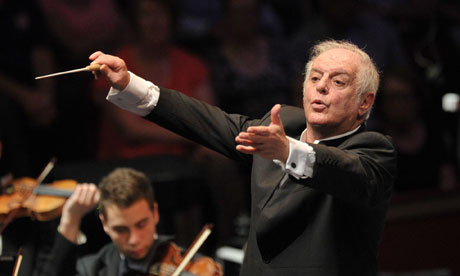
Emboldened to try by myself, two years ago I watched the Vienna State Orchestra concert on New Year’s Day conducted by Daniel Barenboim.

Daniel Barenboim conducts Beethoven’s Choral Symphony

And putting aside the fact that the music wasn’t to my taste, if you can make The Blue Danube rise new to the ears above all the times you have heard it churned out so that you see the river in different weather, its moods, its beauty and its power – thank you musicians, thank you Maestro.

Sometime last summer I saw that Barenboim was conducting Beethoven with his East/West Diwani Orchestra on BBC4 and I thought, well …  I could always switch off.

Instead, I sat in the dark and laughed and cried and watched his right hand lead me into sensing, feeling, understanding as I never had before.  The left hand did the tempo but the right hand was interpretive – and it was thrilling, being led into music.  I felt as if I had begun to read another language.

A famous British academic remarked that the world is full of readers and writers.  I am a reader.

It’s no good anyone telling you that you should or shouldn’t like a voice, and really falling in love with a voice, classical or otherwise, doesn’t happen very often but in dipping into a concert with Placido Domingo. I heard a voice.  I saw a well-made woman in green with no attempt to look like a starlet or a pop star, dress down, hair up, and what a voice !

I raced for pencil and paper and sat, rapt, till she finished, to get her name – Joyce DiDonato – which I promptly  Googled.  Since then I have heard her sing in the first full length opera I have been to for 20 years or more (don’t get excited I can’t afford opera tickets – I saw a cinema link between the Curzon and the Royal Opera House).  In the past I admired the skill, technique and the sheer strength needed to produce the sound: now I was watching a woman who made me believe she sang as naturally as she breathed.

JoyceDiDonato2-1000x300

It was exhilarating.

Music is very personal.  My taste is wide, or no taste, depending on your point of view!   In Greenwich Village when I was 19, we used to say the only thing wrong with folk music is the folk”.  There are sounds and shapes that move and excite and others that don’t even jar – they are meaningless.

The success of AA programme such as the one I watched on BBC4 about the development of classical music after WWI was the range of talking heads, composers, players, and the interested who communicated their interest.  It has always been true that your imagination can be caught by anything if the speaker speaks to you.

My ears are still where they were, on the side of my head, but open in a different way.

Party

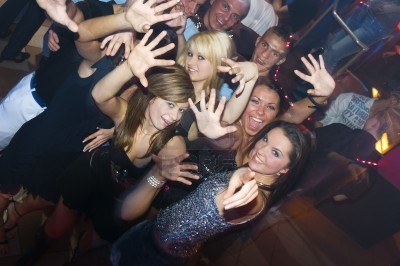
Putting the American use of the word to one side – implying all kinds of wildness, drink, drugs and sex – this is party time.

The pause between Christmas and New Year which used to symbolise some sort of return to normality is now seen as a brief sag immediately followed by a build up to a bigger head of steam. The gap before the big blow out has to be filled with something and what you can’t do with shopping, you do with hooley.

Pass.

I am repelled by parties. They frighten me.

IMG_3354

When I was a child it was to do with looking as I did, thin, dark and aquiline, or as my father put it proudly “like a Hindi child.”

(Incidentally though the Oxford Dictionary says hooley is most Irish or NZ usage to describe a wild party, it also lists a similar sounding word (Hoolee) which is a Hindu spring festival and it would be typical of how language travels if it were of

Anglo-Indian derivation.)

I thought, as many do, that if I could just get the right clothes, I could pass.

It took me a couple of years to attain the long longed-for forget-me-not blue net with puff sleeves and my mother met my eyes in the glass.

“That does nothing for you” she said evenly – she knew I knew.

Belief in the transformational quality of wardrobe took a hard knock.

Wishing does not fix it.  You have to dress what you have.

When I was older (17 in London, 19 in New York) parties happened and I went to them, hiding in corners, finding somebody to talk to, being useful.

You Could Always Find Me In The Kitchen At Parties.

3307788-group-of-young-people-dancing-and-enjoying-inside-a-night-club

By then there were new varieties to be braved – drinks or cocktail parties: “any excuse for a” party: and “new clothes, make a hit” parties: plus more formal assemblies for 21st or graduation.  But none of it did anything for me.

I like to talk and you can’t make yourself heard at parties.

I’m a cheap drunk with a poor head and I don’t like a skinful with any but my closest.

Far from making me feel safe, the noise makes me feel threatened.  I want to know what it masks, what else is happening.

The manic gaiety doesn’t happen to me.

Twice in my life I have enjoyed big parties – where the food and drink came in good-natured waves, everyone talked, the music was low, turned up briefly for a dance and turned down again.

At one, I was thrilled to identify the South African anti-apartheid campaigner Ruth First – but not her husband Joe Slovo (later Mandela’s Minister of Information) whom I thought a charming Middle European Jew, always good for a natter, which is what we were doing sitting on the stairs, when she came up.

947199_10151556188118194_1202157870_n

And  the other given by the William Morris Agency at a famous luxe Belgravia hotel was so beautifully catered and served, the experience of watching it happen was much more exciting than those who dressed the set.

And yesterday we had a party, all two of us, a dear friend and me with some good food and the prettiest table I could come up with.  Candles on, shutters shut.  Bottles of Prosecco (so much more digestible than any other bubbly), gifts – we hadn’t seen each other before Christmas, shouts of delight, trying on, more laughter: wicked bitchery – we have kept each other’s’ confidences for 25 years.

But mostly giggling, carefree laughter, she wandering back and forth worrying about me locking the back door, me with a recalcitrant bottle wedged between lace-covered thighs while I wrestled the second stopper into submission.

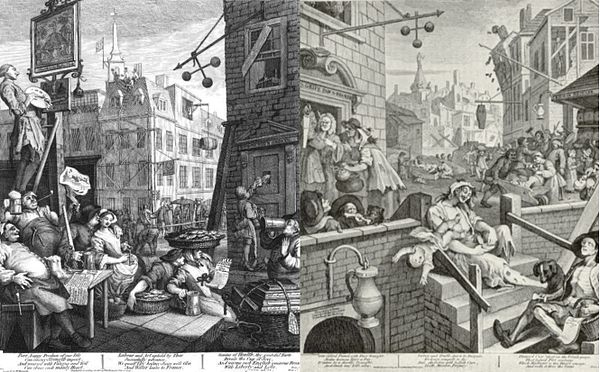
On Sunday I picked up the paper and there is sodden youth.  I am sure there is sodden every kind of age but youth is in the spotlight because of the enormous rise in diabetes (sugar in alcohol) and liver disease among the hard drinking young.

And I bet most of them don’t have a job or an aim or much hope for the future.

Managing them costs a fortune, drives the rest of us off the street and must exhaust the already stretched emergency services.

Makes a nice word like party into an obscenity.

Bear Street and Gin Lane by William Hogarth - he drew, we snap - familiar?

Bear Street and Gin Lane by William Hogarth – he drew, we snap – familiar?