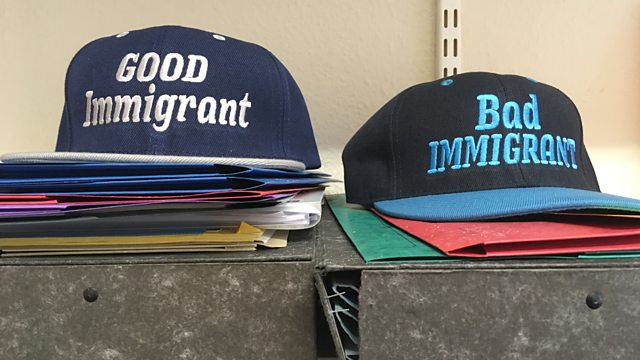
put it on the pickle jar

On one of the rare occasions the post failed me and the cheque to Wal didn’t arrive, I took it over on the bus and on the way back, at the bus stop, signalled authoritatively for the bus. An elderly Sikh

“a turban unwound”

in immaculate grey flannel and dark turban laughed at me. “It’s not a request stop, you don’t have to signal” he teased. When we got on the bus, and were sharing a seat, I told him that in my youth in New York I learned to make proper signals clearly – that way it’s not my fault if the bus driver doesn’t take notice -and we went on from there – to the limp wristed flutter employed by so many (they do want the bus to stop, they just don’t want to be noticed doing it ?) and on into where we are up to (you try avoiding the word Brexit in a sentence of intelligent conversation currently), how long he had been here (44 years), married for 60 which led to me asking where he came from (East Africa) … and he spoke glowingly of Britain and the backtracking of everything he had thought broadminded in British society.

He told me interestingly that his children had, as we used to say, married out – one into a French family, one into a Spanish one – and that it was fine with him. What mattered to him was that his children were happy and cherished, that the extended family (his grandchildren) were part of the same clan.   And as you might expect, I agreed with him. “I don’t care how you vote, who you go to bed with, or what you call yourself if you are a decent person” I offered. He nodded. “You see, we are old enough to know this. I am 80” and I concurred “74”. When he left he shook hands with me, he was off to Spain, I wished him a safe journey.   And when I told a friend about it, she asked (I quote) “And do you think he was hitting on you ?”

As a matter of interest, no I don’t.   Would I have known if he was ? Probably but not necessarily. I remember the man who made the going only to discover between meeting me and having lunch (his idea), that I was 10 years older than I looked and he very nicely shed me.   I remember thinking at the time that I was well out of that.   It stung a bit and made me wary.  I don’t have to lie about my age for work (there isn’t any) and conversational transactions with most of the men I meet are along the lines of a pleasantry ie if I can deal with my birth date, so can they.

I am a 74 year old heterosexual woman. On a good day I look OK, on a bad day, less than OK. Life has been nothing but interesting and still is. I have a soft spot for one of Lord Snowden’s best portraits, of Lady Churchill captioned All Passion Spent.  Labels don’t tell you much and I confess, I am bored with the search for labels.

This morning I read a headline “Bearded non-binary authors have eyes on the women’s prize” and sighed audibly.   Labels for an illness or a condition can comfort people, though it is often only a foothold on a climb. Do you feel better if you were this and became that, and you have told the world how you did it?   As it is, for every person gifted person who has identified as this, changed his/her/its mind, re-identified differently, taken different drugs and had other operations, and delights in telling us all about it (I leave you to opine on the frisson of that) there will be quieter personalities for whom privacy matters just as much to make a similar journey.   I don’t hate trans, I dislike trans disliking me.   Different isn’t better, it is just different. It’s not a competition.   And the journey to some kind of recognition is just as difficult for many of the people who set out upon it, regardless of label.   Labels are for pickle jars.

turning up trumps

When I moved in 20 years ago, a pretty woman from up the street arrived with a line of guff anticipating that I was “her” whom she had thought, remarking “Oh I can tell you all my sexual problems !” to which I replied I’d rather she didn’t.   This same woman confided some time later that, although we would probably never be friends (what she meant was “nqocd” ie “not quite our class, darling) we would make good neighbours and we have. We have done each other small kindnesses, exchanged cards, run errands and occasionally agreed when we met in the street. One requires no more of neighbours.

Literally next door has been a very different story.   The upper flat belongs to the freeholder, a kind woman called Sarah. There must be a story about the lower flat (there’s always a story), owned by a disagreeable man is only interested in the cheque. And over time Sarah and I became horribly familiar with the council “noise line”. The first lot of Aussies never spoke if they could squawk and the Poles, who followed them slept in relays, ate noisily outside and were eventually driven out by the mice and the damp. When the wonderful Max (a prison nurse) and his flatmates (ads for gaydom) moved on, we mourned the end of nearly 2 years’ peace, and in came Aussies (2) who were eroded by exposure to the Big Smoke, getting paler and crosser till they left. Two or three new girls arrived around Christmas.   Sarah and I waited.

A nice note was sent to Sarah saying they were giving a small party – this is already an almost unheard of courtesy – so we waited. The party was considerate (gold star) until I was going to bed much cheered when I heard a thud, quickly followed by two more. I went out into my paved garden which abutts theirs and asked with as much humour and patience as you can put into a human voice “What are you doing ?”   “I am trying to open a bottle,” said an apolgetic young man’s voice out of the dark. “What with ?” I asked. “A boot” he said sweetly. “God’s teeth,” I exclaimed. “Haven’t you got a bottle opener ? I though you were doing someone harm …” He said they hadn’t, I got mine and passed it through the fence, he introduced himself, we shook hands. He asked where he should leave the opener, I said on the wall, he went back inside to a small cheer and I went to bed.

So a couple of weeks later, there I am, swathed in a dressing gown at 8.00 pm, when somebody knocked at the door.  And when I opened it, there stood the owner of the male voice who introduced himself with some fluency as Dan (not his real name), the boyfriend of Lindsey (not her real name) who lives next door and they brought me a pack of named chocolates, to say thank you. And I swept them in.

Living alone and wanting to be liked makes me try too hard and I don’t know when to stop. I did learn that Dan is in recruitment and would rather be in advertising, while Lucy works for a prestigious publishing house. They met at university. And I didn’t have a glass of anything in the house to give them. I offered tea or coffee which they declined so I walked them through the joys of my little apartment and we laughed about opening a bottle with a boot. They have a bottle opener now – I said I was glad, I couldn’t count the times I’d been with people who had the bottle but no way of getting into it. And the house is full of books which they liked. And when they left, I realised that I had been so excited at the thought of them coming to see me and bringing chocolates, that foolishly I couldn’t remember their names. And I had rattled like rain on a roof.     So the next morning I found an organic red which I took round and under the not entirely welcoming gaze of Lindsey’s flatmates, I handed it to her, apologised for talking too much and checked their names.   Which I wrote down when I came home so I can’t forget again.

grey

There is an ad for hair colourant (dye) which boasts “ … and NO greys !”   As if the most terrible thing in the world was to have white or grey hair, a sign of age, a sign of worry. While women familiar and unknown are wont to say to me about greying hair – “Yours has worked – but mine is (or would look) terrible.”   And heaven knows, there are shades of grey hair that don’t do much for the owner, man or woman.

It is fascinating, the number of men and women in public life with every kind of aesthetic assistance who look like hell because their hair colour has nothing to do with anything below the ear, or the skin tone.   Indeed, there is one well known BBC presenter who seemed to fill a bowl with mahogany tint which he clopped on his head for 20 minutes, to remove it and wear it with the white-ish grey sideburn trim, the Bruce Forsyth special, until it began to fade.

Years ago a friend remarked that once you began to colour your hair, you’d probably have to continue down that route and of course we are so apparently convinced that the cosmetic furniture of youth will convince of youth itself. A good example of ambivalence is the injecting of lips which young women seem to regard as becoming while young men can pick them out 25 yards away and sadly avoid them.

Grey is one of my favourite colours.   A bad grey – flat or yellowy, without depth or tone – is killing to wear and good grey is classy, a colour of power and distinction.   However this is an age frequently seen through the prism of all sorts of lenses and artificial light, and grey is difficult to light. Still and all, if we can spend I don’t want to think about how much on unwanted rail links, power stations or third runways not to mention unnecessary prescriptions, you’d think somebody would devote time to lighting grey better.

My favourite story about Fifty Shades of Grey was from a worldly woman friend who’d love a man of her own and bought the book at an airport. “I read the first 15 pages” she told me “and thought, this is hooey … I’m not that desperate !” dumping it forthwith in a handy bin.   Grey suggests temporising, something in the middle, neither black nor white – another reason why it attracts me, trapped as we are in the middle of extremes, black and white of every kind of human experience, contradictions and mixed messages a go go.

It is long established that this side of the pond and especially Britain often inherits US social trends – for example, gang violence, rising divorce rates, the use, abuse and exploitation of those substances we lump together under the heading “drugs”. I hoped that the US epidemic of opioid addiction would be avoided here. But no. Here it comes, gathering momentum, prescriptions many more in the north of England, more deaths there too from these frighteningly powerful and highly addictive substances – and the overburdened struggling much maligned unsupported NHS is expected to try and help.

Adding a US style opioid epidemic on top of half the population over the age of 65 with extended life expectancy if attendant complications, obesity leading to diabetes (the treatment of which is expensive and time consuming for anyone not personally motivated to change), more and more of every kind of young needing psychological help, and no help for those with the Cinderella predicaments of rare, or complicated, or multifaceted ill health – and you will crucially demotivate the caring professions.   People will die, bemoaned in sentimentally shocking newspaper headlines and soft centre news items.  But dead is dead.

Is the apparently willing ingestion of substances that may kill the only way we can reduce the number of people on the planet ?   Is it some form of obscene and distressing birth control –  less thoughtful than the past effort of India in handing out condoms or China’s one child policy ? Is the relatively rich west so sure that it can handle this ?   It may be. I am not.   It would turn me grey if I weren’t grey already.

whatyoucallit


“A rose by any other name would smell as sweet” says Shakespeare.   Shakespeare and the Bible cover most things. And I suppose the inference is that it doesn’t matter very much what you call it, though I confess, it has always mattered to me.   II only got to Miss Raeburn as I got older and I have always like the full name, mine or anybody else’s, unless referred to several paragraphs into a story, in which case the last name will do. My mother went to one of the first co educational schools in London where everybody was called by their last names. I prefer that to the false familiarity of endless first names.

As I lay in bed the other night, unable to breathe and so sleep, I began to read a book called Do I Make Myself Clear ? by Harold Evans, now Sir Harold and editor at large for Reuters.   I met him as Harry when he edited The Sunday Times. The ST published my first piece, probably because somebody owed somebody a favour, and I would be more likely to give that gift horse sugar than to look in its mouth. And Mr. Evans took me to lunch in the unreconstructed Ivy restaurant, from which experience three things remain in my memory – it wouldn’t happen again, he said (“Tina might not like it” ), he had tea after the meal, not coffee (I admired his assurance) and he knew exactly what he was doing.   Such clarity by any name was appealing to me.   I’d have chosen it over beauty or wealth.

When did the hunt for clarity begin?  Not as early as I would like to think.   And that led me to wondering about when did I begin to want to understand better, and about my secondary school teachers, and to wonder whether it made any difference to me that I knew the first names of some but not others.

In my older sharper self, I say that I don’t remember the name of anybody I don’t like. I often remember all sorts of other details (hair, clothes, tricks of speech) – but their names ? No.   Were the first names of my teachers just bits of information, or did the names, by association, reveal something ? I had an overactive imagination even then. I think this started because one of my English teachers had been to school with my sister, so her first name was known and then maybe I began to look for them, to see if I could get to know more of them.   I do not know what motivated me but lying in bed with a cold 60 years later I can still remember those names and the faces that go with them – and my admired history teacher who was Miss S. Phillips though I never knew what the initial stood for.

I like the names of things. I like words.   But if you like them you must learn how to use them – so I was brought up short by a caller for referring to a domiciliary visit – “it just means a home visit” she said. Silly me. But words stick, even if names don’t. I have a friend who remembers no proper name and we have endless conversations in which she tries to place “the man behind the bar in that film about Morocco “ while I ask helplessly “who else was in it ?” We have abandoned that now, she just says a man who … knowing that, with a bit of luck, I’ll trace the reference elsewhere.

So it was the language as much as anything that fascinated me in the first four letters to The Times about the current headlining would be Daesh returnee jihadist bride – all from men – one kneejerk, three considering legal and social aspects of the case. And last night’s news gave me the figure I was waiting for. There are several hundred such cases under consideration, people who renounced their UK citizenship in the name of holy war waged on everything this flawed but old and stable country offers.   No way back.   It’s called treason.

a good week for a cold

Things have got better in the last 24 hours. Why ? Do we have a decision on Ireland or how to leave Europe ? Has the present incumbent of Pennsylvania Avenue gone fishing ?   Is it the will of some heavily draped Arabian bully that peace should break out in Yemen, since a battle is brewing over his co-religionists in China ? No in all cases. No. Things have got better because I can breathe. Nothing like the easing of sneezing to make you grateful for small mercies.

I lost my voice last weekend.

“husky”

(My mother would have fallen off a cloud laughing – “Lord, a pause” she’d have said, handing me hot lemon and honey with the other hand. )   Barbed wire throat, followed by a nose that ran better than any train service in the country.   Relentlessly, at three minute intervals. Temperature went up and down but then so did the weather so I wasn’t sure if I was ill or malingering with self pity. Nothing like a head cold for making you feel like the Wrath of God . Definitely a weal on my wellness like a blister on my heel.

Long ago, I remember my son rereading his favourite Dick King Smith about Magnus Powermouse the night before an exam. And his explanation: “it makes me feel better.” The pile of books I was given for Christmas had to wait because they required me to think and I couldn’t. I reread old favourites, soothed by a hot water bottle and wrapped in a blanket. Televisual images swum past my fevered eyes as I watched the news – I am always afraid the world will come to an end without my knowing, in plain language, that I might miss something – but you do have to control how much news you watch because “rolling news” is a snare and a delusion.  It doesn’t roll – it lumbers and BBC ads – relentless promotions for their product – are now nearly as repetitive as those on ITV and almost as irritating. Is there a first prize for that kind of negative achievement ?

I cancelled everything including lunch with the Fire Fairy at the Polish Officers’ Club (it will keep)– only she could know of a second Polish restaurant where most of us knew of one. Food tasted of nothing very much and I don’t want to share my bug with those I know or don’t know.

Flu Prevention Poster Sign

All that “soldiering on” just means more people get sick.

Apart from going out to get the papers and lemons (same shop), I stayed in. I substituted loo roll for tissues, moving every 15 minutes when I wasn’t out for the count, mouth agape, virally stunned. Part 2 of Inside Europe was wonderful – how to make a documentary (1).   The re run of The Making of Modern Britain, written and fronted by Andrew Marr, this segment about Thatcher was htmad (2).   On Wednesday morning I turned into AR of the airwaves

“Bossy Boots! – really”

when I recognised somebody telling me of a very difficult situation as an LP caller – round and round and round and we might get to the middle. Since the middle is often crucial, certainly in this case, and going repeatedly round the houses has been going on – again in this case – 20 years, I asserted myself with a voice that I hadn’t used for 4 days.   Sadly drastic situations require drastic solutions, the avoidance of which is where this all began – so while whatever I said was well intentioned, it was probably useless.   But I did laugh to hear myself and my throat hurt afterwards which – as Mrs. Overall would say – is God’s way of telling me to give over.

I am sorry that in rushing to PC, the wider reference of what Liam Neeson said was ignored. How wonderful to hear Donald Tusk say what he meant, after a two year debate cruelly characterised by hot air and evasion.   The lavender temple balm (my temples, no church in the garden) does wonderful things for my nails. And I read a piece in the New Yorker by Robert Caro that made my heart sing.

free

We were a full house, me and my son, his daughter and his oldest friend. OF brought tulips for me and separately, a small bunch for Babygirl.   Picture us, strung out from the kitchen (down two steps) along the hall, OF with Babygirl and her flowers in his arms, me and my son behind me in the kitchen and I said “I know a song about tulips” and began to sing “Tiptoe Through the Tulips”, both men joined in, we sang it twice and Babygirl beamed.

She is three and early on, we discovered that if you could sing , she loved it. We made up silly chants and sang all of The Twelve Days of Christmas twice, just so she could watch first one and then the other of us, and join in Five Go-old Rings ….

There’s a line in an interview with an actress called Jessie Buckley which caught me –“… singing is free”

“the nightingale I am not”

and it made me think how, now that I have accepted that I am not a singer in anything except intent, how much I enjoy it and always have.

Both parents sang. My mother had a true little voice and she sang songs that were old then, often from films or early records.   My father sang bass, cowboy songs (same provenance), Paul Robeson and The Deep River Boys.   Once we got a car, in almost every outing, somebody would begin to sing.   As soon as I learned it, I sang Rock Island Line,longing to learn more old blues and work songs from the Alan Lomax programmes on what was then the Third Programme. The sounds entered my mind forever though I could rarely reproduce them.

We sang at school. In my junior school, Community Singing incorporated folk songs and many of the politically dubious numbers from a just about post Imperial world which remain indelibly in my mind.   (You never know what a song may mean until you sing it to somebody who hears it a different way. How proudly I sang the tune I had learned for The Diary of Anne Frank (on stage) to have Dov, an Israeli, put his hands to his ears. “Not again” he groaned. “We grew up with all that stuff !” I sang a Boer War marching song to a friend from SA who howled “Good Lord, haven’t heard that for years !”)   Music as history: discuss.

In among the madrigals essayed by my secondary school choir, I saw for the first time the phrase “from the opera so-and-so” printed on the sheet music.     For the unsurpassed carol service, we sang carols from the Commonwealth, settings by Benjamin Britten and The Song of the Nuns of Chester (in Latin) which remains in my ear because we sang in language divisions – French, Latin and German. I couldn’t wait to be in a year older and learn the second French carol: I remember them both.

I saw musicals at the cinema and on stage occasionally, thanks to the local Amateur Operatic Society, who trilled earnestly in private and gave voice to much lighter weight stuff for public consumption.   All three of us learned songs from the screen and they were added to the singing part of our car journeys. (You may be relieved to know that we sang very little and very quietly if on trains.)

I sang the night my son came into the world, I couldn’t sleep, but lay there rapt, blood on my best cotton nightie with this wonderful great boy in my arms. A nurse came in briskly, relaxed into a grin and left saying “ Well I came to check up on you – but you’re fine !”   I sang everything I could bring to mind and he watched me thoughtfully.

I have sung when I am lonely, I have sung when I am drunk.   I have sung from the back of open topped vehicles (trucks and jeeps) and that’s probably why I love them.   You can make a noise up there and nobody can hear you. I have sung in the darkness, as I lay in bed, often a song that creeps up from nowhere, on a wisp of memory. Free.    

two wolves*

The woman walked through the doorway,

“red anemone in the negev”

looked at me and came straight towards me with her arms wide so I stepped forward into her embrace and we stood together, saying not a word. When she disengaged from me, I looked at her, she patted my arm and she went on into the small hall where I was due to speak. One of the younger women, overseeing the entrance , said “That was lovely, is she a relative ?”   “I don’t think I have ever seen her before in my life “ I said. I think of her often, especially today. She was a survivor of the Shoah, the deathwind.

I was in my thirties when I first heard the phrase “survival guilt”, the idea that there was a cost beyond simply being glad that you made it and went on living, when other poor souls didn’t. Most of us don’t have grand philosophical thoughts about why this one died and that one didn’t. We just want to survive.   But there is a cost to survival.

The most usual, the most ordinary, is to cherish what you have, that the other person lost – your health, your home, the people you love, the pet, the flowers in the garden, every silver moonbeam, every sunny sky. That sort of person can always find something to give another because they know what can be lost.   Beyond that or aside from that, there are people who can’t sleep or can’t sleep without a pill or a potion or a drink and that is a permanently extending kind of palliative. There are people who can’t bear to cherish – it’s too emotionally expensive, too risky: you may be disappointed, worse it may be taken from you. Again.

Most of us try to balance between the difficulties of our lives and the blessings. You can ascribe all sorts of things to that sense of balance, how you were brought up, who your parental figures were, the work you did, the people you met, your innate sense of self.   But when all these things have been harmed often hideously and wantonly, destroyed, pulled away like skin from flesh, over and over again, in everybody you knew – you begin to see why healing is sometimes relative at best and balance is difficult indeed.

And perhaps balance implies taking time out to weigh everything and sometimes that means you don’t answer as you wish to, but as you think you should. Though sometimes, too, it is helpful to know how you wanted to answer, even if you felt compelled to answer differently.

The internet has let a genie out of a bottle and even in Disney’s “Aladdin”, the genie was nearly overwhelming. Power isn’t good or bad, it’s just power – good for you maybe, same power, bad for me. There are all kinds of wonderful things about the internet beyond shopping and talking to your grannie in Australia, but you don’t have to look very far to see horrors. I have come across things from the slightly distasteful to the frankly abhorrent, just looking for pictures.   And as my son taught me “If you can find the question to ask it, it will give you the answer”, in a frame of reference that is very easy to learn when you are young.

Reading about Molly Russell who killed herself aged 14 and how her family have tried to understand what she watched on the screen, what she saw, how it affected her – we might reasonably conclude that if it is hard for a grown person to find and maintain balance, it is much more difficult for a youngster. I am not in the habit of underestimating the young though I can tell you as one who works with words, that much of what is written is open to the interpretation of the reader and most of the readers want desperately to belong, not to be different. They have already imbibed one of the most sinister messages of the age – they fear that difference kills. And if there is a risk of difference, those clever words endorse your darkest fears, and offer another kind of killing wind.


Holocaust Memorial Day 2019

*Cherokee legend

gardening by hand

It’s wonderful when you have written so much that you have to go back and check before you start again.   Well, it’s wonderful to me when I think of how hard it was to persuade me to do a blog. Was I scared ?   Rabbitfaced.   And I have written what I want to write about – no editor, producer, suit or publisher to account to, nobody’s wishes to fulfil or placate.   When it has worked as it sometimes has, I have shouted with joy. And when it doesn’t, I remember “must try harder”.

Most of the time, I think of my life as I think of my fingernails, permanently a work in progress. Whatever the feminine edition of Samson is,

“Norman Rockwell edition, looking suspiciously like Victor Mature”

I am she because all the strength has gone into my hair, leaving nails like tissue and, short of the modern edition of an old fashioned studio contract where devoted minions justify their working lives by trying to repair the damage with oils and massage, unguents and idleness, I can’t see me making much headway. But I try.

I have lost hope of every “miracle cure” before I ever try it, though I do occasionally find things that are of benefit. I won’t subject you to a recital. To each his or her own.   The endless hyperbole of the perfect answer eludes me. Superlatives I can handle – I use quite a lot of them – but the constant inference of perfection puts me quite of temper. How happily named is The Favourite: right on the money.

Look at the BBC’s show on Icons – one over all ?   Cultural fascism. A healthier idea is that we live in a world which embraces the widest possible range – bits and pieces of as much as the individual can favour or understand – and while when you are in the middle of it, it may be exhausting and frustrating, at the same time it makes room for a lot more people to excel, whether in leg length or astrophysics. One over all is just a popularity contest, it’s about who appeals to you because in many cases you won’t know the name or the endeavour, you’ll only recognise the face and say (as a friend of mine does over and over again) “I always thought (s)he was a nice person” not knowing more than the fulsome paragraph she has read somewhere accompanied by a benign photographic image.

And let it be said that very often, people of great gifts and achievement are anything from a bit difficult to absolutely horrid.   And secondly let it be said that because you’re relatively attractive, that doesn’t make you honest or caring or likeable: it just means the success package may be more easily placed.

Some people appeal to us more than others and choice is personal. Others produce in us an absolute sense of withdrawal. You can’t help it – you don’t like him or her or it.   You just don’t.   You can try to analyse this and come up with some small particular that has jarred but you don’t get far.   Whatever it is, you recoil. End of.   And when you think about it, this is no more unlikely that its opposite, where you are open to persuasion and are thus indoctrinated to like this bread or that body, that smell or those shoes, by the apparently unending incantation of certain vocal themes, music, associations, colour, people, pets – anything that will make you accept that you do want whatever it is that’s on offer.   At a price.

The most useful thing about identifying my life with my nails is how long it takes to make a difference.   And I don’t mean six weeks’ long , I mean long long. In a world of mixed messages (they always were mixed, there were just fewer of them) you can see why gardening is so popular for no matter what you are promised, the process will take as long as it does, depending on weather, soil and how things work out.   Very few people are so gifted or technically apt that they can change those odds. The commitment to today leads to the commitment to tomorrow. I just wish I could find somebody who grew fingernails.     

choosing

Time can be measured, the measures can be named, but time is.

“Gold 18th century time measuring device”

It cannot be stopped. The sun comes up and the sun goes down but when there is no more sun, it is the end of everything we know and I don’t mean KFC. Casting about for a place to begin this morning, I looked up January. The temptation to dismiss January as a month of cold Monday morning is considerable. What I found was Janus, the two faced god, he who patronises (I quote) beginnings, gates, transitions, time, duality, doorways, passages and endings. I was momentarily soothed. The image was January as a work in progress. Better than headlines screaming disaster when there is damnall I can do about it.

This January one of the kindest women I know eventually began to realise that she was kind to everybody but herself.   Her behaviour has altered. She is (dare I say?) steadier.   This January another friend who has had a year of upheaval including the disintegration of a long partnership and the hospitalisation of a beloved niece finally faced some uncomfortable truths – and promptly bought two dresses. Hasn’t happened in 20 years. They are targeted sale buys as she is about to go into very much warmer weather, travelling in the job that has kept her sane over this “passage” period, out of one set of things and into something else. Nobody would deny it was painful but at least there is movement.   Janus.

We usually think of two faced as being a bad thing. It can be. Most of us have been let down or felt ourselves to be so, by a work colleague or an intimate, or even at the hands of a professional we trust – and it is painful. We say “There are two sides to every question” but that’s minimal. There are all sorts of aspects to everything. Looking for things to be simple is misleading and frustrating.

Another friend’s eyes were streaming. And they itch and they hurt and you must know how miserable that is. But she was prescribed certain eye drops and that’s what she has used – not the same bottle, but the same stuff, for years.   I suggested she might question this, with the doctor (not big on the GP), OK, with the pharmacist (she has a tame one locally) or even with an eye specialist – a one off but sometimes worth it. Things change. Janus.

Not everybody has means.   But most of us have some means and it is important to have them for what you need them for. Always prone to migraine, I had a run of what I called headaches recently because they took place in the head but they were characterised by distortion of vision, not pain.   There was a particular one where I went to put a face on a GP who has gone out of his way to be helpful. Until now, we’d not met – communication had been written and once by phone. He checked me over and commented on slightly raised blood pressure but was honest enough to say it was in no way conclusive. I went home, thought and went back (more money) to my eye specialist, he who had melted in the summer heat into a much more accessible person than I had first thought him.   He listened, ran the tests again and referred me to a neurologist who specialises in headache.

The latter recognised every symptom, explained, put me through all sorts of balance and co-ordination tests, explained some more. Nice man, cost the earth.   But I left him knowing how to proceed.

The other day I fell in love with a Braque lithograph. I recognised it, it took my breath away. I priced it.   And the admirably approachable owner of the shop reduced it, almost at once, but I went away to think.   And this is what I thought : God forbid I should be so unlucky as to have a brain tumour but if I have further problems, I have already put my hand up to transfer back into the NHS clinic of the neurologist I consulted. I have a reference point, I know how to proceed.   It is 2019, the NHS is overrun, small specialist crisis like mine are casualties of its purview. Janus turned his face against the Braque, better uses for the money.

“thank you Braque, also the name of a hound – Janus rules”

slimming by ear

I am very worried. I have just found a Gwyneth Paltrow recipe I like. We get so used to the wilder shores of her successfully realised snowflake/woebot/neo-vegan/professionally twee extremes, that we forget she is a well educated upper middle class survivor and this clean but not mean gurudom has got to be better than lingering around the ego-beatup that is Hollywood. Don’t get me wrong, I’m sure she works, for nowadays it is axiomatic to see the hardwon pile driving effort that goes into anything that succeeds. (Good Lord, I am exhausted and I have only written six lines …) It’s wellness that does it. How I hate wellness. Boop-a-doop Goop, I can just about get on with – I know a girl has to make a living – but wellness brings me out in hives.

The concept is OK, it’s the word. I don’t like it. It’s arch, false, designed to sell something . Growling slightly, I just about got my head round wellbeing but wellness gives me the pip. A phrase like “everybody’s toolbox for optimal wellness …” and mine is instantly compromised by a combination of repressed fury and uncomfortable laughter. Irony bypass. I am so glad that I am not young any more …

In the ear or on the page, American voices were and remain a different section of the verbal life orchestra, starting with the movies. New York introduced me to all sorts of new words, some of them frankly bewildering, suspenders and fags among them. Language is always on the move, slang to start with (the vernacular) and then language proper. It is after all a scant week since I read the 400 pages plus of Becoming by Michelle Obama – and it pains me to tell you that there is a wellness in there. I am sure it is correctly used, I just don’t like it.

But I read a lot of American writing, I always have since I was introduced to Arthur Miller at 13. And I could see differences in the language, in the uses of the language and I can’t remember being troubled by it. Trouble began in would-be “take me seriously” texts, usually from law or medicine or sociology or any of them via media – the language of most US TV series based in or around the law required a working knowledge of their legal system and a very sharp ear. Same with politics. Or health. And health is politics. And all of these extensive subjects are dealt with by degree – enjoyment, information, documentary, soap … and subliminal marketing.

05f8766c-6dcc-4ebd-8b7d-a89709c42804

I hear US voices , because of the dominance of culture, especially pop culture, but also because my favourite news programme is dually anchored (mostly) Washington DC and London and it is their pride to offer speakers often unknown to me (hooray )– most of whom express themselves extremely well (often my experience with American guests when I was broadcasting.) They know (and knew well in advance of most of us this side of the pond) that to promote themselves they would have to be open to and accessible by media – and they were brilliant. Brilliant in their version of my language, not a wellness in sight.

Wellness is a cod term, a carefully composed lipstick red herring, all dressed up and only going to the bank off the back of diet books. Sure, it’s important to get people to eat more vegetables and less meat. But as importantly, we need to understand why some people eat more than others and why some find it so hard to lose weight. And for that you need a different voice – the voice of the scientist slogging through time to understand a very complex matter. Watching a friend who has just lost 70 lbs put over half of it back on, I fell on a review of geneticist Giles Yeo’s book Gene Eating (Seven Dials £14.99) – and the most important word is health – the middle of NHS which is staggering under our collective poundage and the illnesses it accrues. “Science” says Yeo “is set up to get at the truth eventually.” I’m off to the bookshop. I’ll walk.