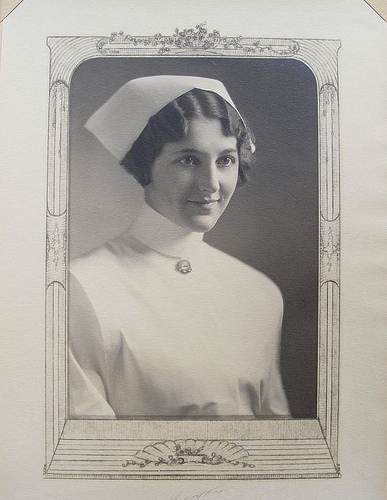
Jane Taylor

“My mother inspired me to feminism” said I on Radio 4’s Reunion to Sue McGregor.  “She went back to work when I was nine (and she 53) and made something out of nothing.”

She was asked “Can you type, Mrs. Taylor?”

“No” she replied “but I can use a typewriter.”  She got the job and “can do” was embroidered on her name tapes.

I can use a typewriter

A year later, she was given a pay rise, a title (Deputy Superintendent, Women’s Educational Centres) and over and above considerable administrative duties, began to teach English and Arithmetic to student nurses.

“Why do you want to work?” I asked as if she didn’t already.

She replied, hands always busy with something – washing, folding, cleaning, peeling, feeding the dog – ”Your father would give me anything that we could afford but I want to buy my own.

I don’t want to feel guilty every time I buy a lipstick.”

Three years later I watched fascinated as my father removed a wad of money from his jacket, put it in front of her place at the table and asked for his cigarette money.   The joke was arranged.  She grinned, he grinned and I grinned too, asking “What is all that money?”

“It’s called a Chicago roll” he said, “what gangsters carry.”   It was his month’s salary.

Month's salary

Even with both of them earning, there wasn’t very much and he disliked money.  But, liberated man, he boasted about how much better she was with it than he.


She was generous with him, with us, with me.  Her indulgences were Tweed eau de cologne by Lentheric, Aristoc stockings (in boxes of three) and having the sheets laundered.

She bought her own clothes, most of mine and spent wildly on my shoes.  Her feet were terrible, shoved into a size too small after her father left and money was tight at home.

She had her hair done once a week, slathered her nails in almond oil, kept house, walked the dog. Read a daily newspaper and two monthly magazines with a far higher quality of editorial than we have now plus the National Geographic and some part of a book every day.  She and my father were enthusiastic moviegoers and both liked to learn.

This is the woman who when I asked her what class we were (I was 14 and it had come up at school) replied crisply

“Educated darling, and there aren’t enough of us.”

08_08_19_laundering02

She hated her name and once I asked her if it was ever shortened to Et or Ettie as I had read somewhere.

“Briefly” she said, face like a thundercloud.  “Ethel is a horrible name.  And Maud.  We had a golden retriever called Maud.”

Years later, I told her in conversation about some friends whose beautiful Chow had run away. ”What was it called?” she asked.

Unthinkingly I answered “Ethel”.

“Well of course it ran away” she expostulated.  “Poor dog!”


She was frustrated by the lack of much social life – my father was an intensely private man -but after his death, she had 15 years of neighbours’ suppers, lunch with friends, the Pensioners’ Club, outings to the theatre, grand gardens and places of historical interest.  If her formidable and very real charm failed her, she lined up what we called her steely blues with a temper made ferocious by its clarity.  I recall weeping as a small child at the sharpness and suddenness of it till she said quietly” Now, stop it.  I know I make a noise.  But it’s over and done in a minute, and I don’t hold grudges.”   And she didn’t.


We had an awful parting, for reasons too long to go into here, but I remember her as wildly funny and quite extraordinarily patient with a difficult late child who was often odd and ill.

“You’re a changeling” she told me.   “God knows where you came from.”

But she supported me through illness and endorsed my efforts, arguing and appreciating.   She even understood why I changed my name – because she changed hers.

She felt that the heroine of August in Avilion by Ella Monckton was so like her that she took her name and there we are, photographed in Tatler when I had spoken at the Women of the Year lunch –

“Mrs. Jane Taylor and her daughter Miss Anna Raeburn.”

end

A Day of Meetings

A day of meetings sounds very professional and business-like.  My meetings were purely pleasurable, beginning when I went out to buy newspapers.  I used to by three a day, five on Saturday, and two on Sunday.  Now I am down to two a day and one on Sunday.

But they make me think, I like them, I like the convenience store where I buy them and the walk there and back.

1

As I returned, a young man, bearded and bespectacled, came towards me preceded by a small smooth coated dog, bouncing along full of joy.  A dog lover, I like to see a happy animal and I bent to acknowledge what I could see was a she whereupon she went all shy on me.

I asked her name.  “Sophia” answered her owner with the short Italian ‘o’.

“Like Loren?”  I said.

He beamed.

Document-1-page001

Later I let a woman on to the bus before me and as we sat together, said “I was going to say – beauty before age-”

“Not much in the age, I think” she said kindly if untruthfully.  Rebecca introduced herself as a jewellery teacher, currently exhibiting the Goldsmiths Fair, mother of a fourteen year old daughter.

When she got off, she waved. Nothing to do with new best friends – it’s called passing the time of day.


On the next leg of the journey, a tall heavyset woman in a beat up black suit got into the now empty bus and clawed for her bus pass at the bottom of a capacious handbag.  As there was nobody else about, I ribbed her about the size of the bag, she answered in kind and

I could hear something in the fluent English, beyond a demeanour that wasn’t home-grown.  I asked where she was from.

3

“Germany a long time ago – Berlin” she said.  I said I was just rereading The Gift Horse by Hildegarde Knef, Germany’s first international star after WWII, having learned over time that Berlin is a s much of a one off to Germany as London is to England.

“My sister adored her!” she exclaimed “Such a life!”   “But what a writer” I countered.

“I hesitate over the translations” she said.  “You know, I tried to read Falada – Alone in Berlin?”

“Michael Hoffman translated Alone in Berlin” I said.  “I thought that was OK.  But other than that, I agree with you – and I don’t speak German.

You just know the translation is sticky …  Do try The Gift Horse.”

The bus stopped, we shook hands, her name was Renate.


And then I went to buy the converter to make it possible to charge the electric toothbrush the chemist had been so quick to sell me but had never mentioned how I could make it work.  The men in the electronics shop are unfailingly helpful and laugh when I say

“May I ask a dumb question?”  I went to the supermarket, the bank, the second-hand bookshop that was open, stamped my foot over the second one that was closed and met a small wall of musculature in the form of a Stafforshire bullterrier on the lead to an raffishly elegant 35 year old who adored him.

“His name is Slasher” she said helpfully “Slash for short.”   He hid modestly behind his mistress’s leg, she and I enthused over bull breeds, bemoaning owners, until I relinquished him with one last stroke of liquorice coloured brindle.


This is a very large city but there is an area of it that is wholly familiar to me.

I have known it at all stages of my adult life, I know where things are.

I went and droooled over eye makeup and skin care,.  I look at these things the way richer women look at diamonds but

I doubt if they enjoy them more than I do.

And then I went to get the bus home having bought none of them.

4

On the bus in front of me was a tiny woman with very short hair atop a face of almost medieval symmetry, who was plainly worried about something.  She strained to see where the bus was going.  At one point, she got up to see and then sat down again.  I leaned forward and asked where she wanted to go.  As it happened, she wasn’t out of her way.  She was just rushed and fussed.

But then as we approached the junction of Brompton Road and Knightsbridge, she began to talk about a bunch of hideous monumentally wealthy apartments and the traffic has never recovered.  She knew so much, I asked if she were an architect.

She shook her head and her bus stop came, stood and gave me her hand and her name, so I did the same.

“Ah” she said, smiling into my face.   “I thought I knew you.”

The Bowl as Witness

As I lingered over an elm salad bowl 35 years ago – and it wasn’t cheap then – my mother offered “I’ll buy it for you ” and, as I hesitated, she added
“On one condition. You take it with you.  You’re always saving up for something and then you move on and leave it.   Look at the stuff you left with Michael .”
I forbore to answer that the end of my first marriage after five years didn’t seem like the occasion for an argument about who owned the rosewood handled steak knives.
I promised I would take the bowl with me.
spalted-london-plane-bowl
When I left my husband, it was not as has been alleged because I was a ravening careerist.   Not me.   I could have been impressive in the role
but I never learned the lines. 
I left my first husband because I couldn’t breathe.
Beyond him, over his shoulder, I seemed to see a circular porch leading to a whole corridor of other doors and I knew that if I stayed with him
I could never get into the revolving door, let alone open another of the doors behind him.  He really was a ravening careerist and if you made second on that list
to film, you were doing well.  I think I made third.
So somehow I met and went to live with a wonderful talented madman who had a house in North London which seemed like riches indeed to me.
I never had anywhere settled to live.   Which means I didn’t want it or I expected it to be provided.  (“You’re in love with the house” said my mother dryly and she was probably right.)
But Leon (not his real name) was the only person who ever encouraged me in our delightful time together to try some amiable form of bondage, using soft ropes and high beams while wearing a black lace corset which looked wonderful and was (in Cilla Black’s phrase) like wearing Brillo.  I laughed myself silly till he was thoroughly put out and put off, and released me. 
The bowl was witness.
overhearing
I moved out to live in a cupboard somewhere in the area where I never really unpacked because there was no room and I hated it.  Waiting to be rescued, you see.
But then I met Joe (not his real name)  who had a small business, devoted friendly parents and who told me he had never had a really successful relationship with a woman.
I don’t mean that he was really into men – he just thought he wasn’t very good at women.   Which he proceeded to disprove in every possible way with me.
He was funny, he was practical, he cooked like an angel – and I made the salad.
Enter the bowl.
He also revealed himself as somebody only lacking a little encouragement to be a major horizontal event – talk about making up for lost time.
And in those carefree days of largely reliable contraception, HIV and AIDs unheard of, before the miserable days of “having sex” which puts it on a par with a cold or an overdraft, and competing all over the media
– it was, dear reader, one of the very few things I was any good at.
And the bowl saw it all.
I left him because I fell in love with Dov (not his name), another undervalued man just waiting under the gooseberry bush of chance for encouragement.
He was wonderful, intelligent, amusing, thoughtful… At their first meeting, my mother came out to the kitchen to say “Well, I can see why you’re with him.  He’s beautiful.  But he’s a boy …”  (Four years younger than me and I didn’t do that often.)
But he didn’t want to marry, he wasn’t ready for children and he was a Jew.  His family wouldn’t like it.  I offered to make a conversion (my father was a Jewish son).  He was appalled.
Heart-Broken-Bowl-Shadow
I never fell out of love with him, I just buried him deep in my mind, one of two men I would very much like to meet again and talk to because they meant something so important to me and –
like a fool – I only realised it in retrospect.  We didn’t argue very much, we just drifted.  
And the bowl watched.
Fate intervened.   She (I just know fate is a woman) sent me my second husband who married me, fathered the son I love, behaved well, less well, shabbily over 20 years.
In the family we were, we used the bowl daily.  One night, I was speaking to a group of Jewish women and I referred improvisationally to my husband as Supergoy.  They laughed and I knew why.  Sadly, I wasn’t one of them but I wasn’t one of him either.
We fought.  I shouted.  He tried to frighten me.  It is said “perfect love casteth out fear” so I think I must have loved him very nearly perfectly because I was only afraid when he was gone and I knew that was it.
I took everything that was mine including the treasured elm bowl.
Heaven help me if the bowl speaks.

The Tree

Perry (not his real name) was a lonely awkward gay with a good heart: adopted by punitively religious people who rejected his nature from its earliest beginnings.  The relationship between us didn’t always connect and finally disconnected over his desperate need for somebody, anybody.  But before that, there were good times and one particularly happy afternoon.
TreeArt1
I had seen Millioin Dollar Baby, a story about another kind of love, not just partners but the parent/child variety.  We are short of stories about the love between friends (not buddies), parents and children without use or abuse, siblings without incest or goo.  And I wanted Perry to see it.  He was appalled – “Clint Eastwood and women boxing !”   I explained that there was more to it even if some of the scenes repelled him.   ( In the event I took two gay men to MDB and they both wept).
After the film, when we came out into the afternoon, he said “I’d never have seen that without you and I am very glad I did, so let’s get that plant you wanted.”  I am not a gardener but I love the blue of ceanothus, though this is a story about my ignorance.  I had no idea about varieties of plants.  He bought me a slip for £11.
In those days, I was busy reclaiming the garden from voracious houseplants that had mutated into something like the net base of a wig, making it impossible for anything else to grow, and pulling out anything else I didn’t like that was left.  I had moved a shrub from one bed to another (the garden is about 14 feet long by 4 feet wide) but it didn’t like that and gave up.  So, wanting one of my own, I took out the old and put in the new, where it took and prospered.
There were other successes about the same time.  From a wife who had things done I became a woman who did it herself.
Somebody sent me a saying : if you want to be happy for a short time, get drunk: for longer, fall in love: forever, take up gardening.   Heaven knows how many things I did wrong, how many mistakes I made but I learned from the garden – patience, persistence, the change of every day, apart from the bigger change of the seasons, while looking out through the cold and snow, when all my neighbours are asleep or away, when it is blessedly tangibly silent, framed by what had become over 6 or 7 years a substantial tree, was a gift beyond expectation.
Dead_trees_at_Mammoth_Hot_Springs_1
But it became clear (oh dear this is a moral tale) that all was not well in Eden. Which is to say, I planted other things in that end bed near the ceanothus and they did not thrive.  Some were plants bought from a man whose sole criterion is cheap – they’re cheap, he gets them and other than cyclamen or geranium, they do not “take”.   Other plants were bought more discerningly but the soil didn’t agree with them or something else went wrong, I don’t know.
And then I bought from a reliable garden center a sea thistle.   And it died.   I began to look at the ceanothus differently.  It ate the light, I didn’t mind that being generally a mole, but it siphoned off nutriments from other things so they could not flourish.   Last year I climbed round it with the aid of a nearly tall enough ladder, gardening gloves and sharp secateurs, being very careful not to fall , and thinned it with a vengeance but this year with the earlier rain and the later sun, it was sticking out the equivalent of its botanical tongue and taking over.  So it had to go.  Two men came, cut the branches, disposed of them and I learned all over again why the buzz saw is such a popular implement: it takes no prisoners.  The trunk was sliced up and a substance put in to shrink and disperse it.  “It will take a season” said the older man.   We’ll see.
small-trees-for-gardens
Cutting down the tree was a big deal for me.  I like trees.  The local council works hard to maintain the ones in the street.   I like the symbolism of the tree, “I think that I shall never see/a poem as lovely as a tree”, the time it takes to grow and change, its processes through weather and season but sometimes just growing something isn’t enough.  It’s like those people you see for 20 years to whom you have nothing to say.  The good gardeners I know have a ruthless streak.  They can make a decision.  Did making this decision make me a gardener?  I doubt it.  But the removal let in light so dramatically that you could hear everything murmuring “Oh wow, light, air …” with an almost audible sigh of relief.  And it promptly poured with rain which settled everything down.   
And I remembered one fo the few dreams I had ever been able to recall and work through with my therapist – something about dead wood.
CEANOTHUS_ARBOREUS__2

More Than Pizza

However uncomfortable it is, I can never feel badly about sunshine in England.  It doesn’t happen often enough for me to complain.
I was walking home, the last leg of a considerable journey with a laden basket, when a young man waved at me from across the road and came to meet me.
Document-1-page001
He was immaculate down to laced up patent shoes which I thought abstractedly would be terribly hot for his feet.
“Signora” he began, Italian obviously, and speaking English so fragmented, it made the Sopranos sound like Shakespeare.
And on a Saturday morning in South London, he was looking for an Italian radio station.
He offered me a notebook.  I asked if he had been to that address and eventually he managed to convey to me that whoever he spoke to wasn’t helpful.
I saw another name I thought I recognised and pointed at it but he said they didn’t know anything.   I forbade myself to even think that they might not have understood him.
We were very near my flat.  “Come with me” I said gesturing, my six words of Italian wholly inadequate to the occasion.
He looked taken aback.  “Computer” I explained.
When we arrived, he asked me if he might enter – ” Permesso ?”
At the screen, we typed in the name of the radio station and were referred to the Italian Chamber of Commerce in London.  After trying it three times
and checking through Directory Enquiries, it was found to have a fault on the line.
10
I discovered Fabio could read English, even if speaking it was a problem, so now everything was scribbled on bits of paper.
The telephone operator suggested the Italian Enbassy and connected us.  I got an Italian national and handed Fabio the phone.  Long dialogue.
I went out of the room.  He called me back to hand me the receiver.  Said the embassy employee “Signora, this is Italian Embassy.  We deal in culture, not radio stations.”
I believe in radio for all sorts of reasons and am the wrong person to say that to.  “Great attitude” I said coldly.  “I have one of your nationals in my apartment.  You might at least try to help him.”
Wuffle, wuffle – same in any language.  I hung up.
Fabio suggested the Italian Consulate.  We found it and heard one of those digitalised women’s voices that make you want to swear saying “The person you have dialled is not available, please try later.”
As Bob Dylan once sang, “She said that for over an hour and I hung up” only I didn’t wait so long.
Fabio asked to try Facebook but something didn’t work and we could do no more.
I went to get us glasses of water.  We shook hands, he kissed me on both cheeks and we parted.
I emailed the Italian Chamber of Commerce who replied three weeks later that they had no knowledge of an Italian radio station in London.
Lucca
In Donna Leon’s popular books about Venice (where she has lived for 20 years) she expresses through the mouths of her central characters utter disillusion with what we might call the infrastructure of the Italian state.  The only nationally recognised force that works is the Mafia.  This adds spice to the personalities and their adventures but if I thought about it, I thought it was an overstatement.
The British all moan about this bureaucracy or that, especially when it encroaches on our time or doesn’t give us the answer we want.
We read or hear stories of difficulty in one country or another and feel obscurely comforted that our national situation isn’t as bad as that.  And of course, a telephone line can develop a fault, a voicemail may be loaded erroneously.
But I never thought of “don’t know, don’t want to know” as a watching brief for the meanest employee at an accredited embassy.
Couldn’t he have explained to Fabio that Saturday isn’t a great day for trying to locate things in a city you don’t know – better wait till Monday ?  Was that outside his brief as a human ?
Two days later in a jewellery shop (cat can always look at a king, looking is free)  I met Antonia from Bari in the south of Italy.  We got talking and after she had told me how much she liked London even though she couldn’t understand drinking till you fought or fell over, I told her about Fabio and the accidents of fate that prevented variously the Chamber of Commerce, the Consulate and the Embassy from trying to help him.
She made a speaking gesture.
“You’re not surprised ?” I said.
“No” she said simply.
James Gandolfini in his role as Tony Soprano

Dirty Clothes

Although the notion may not appeal, clothes soil.   Whatever the cleaning arrangements for public transport in London, they are inadequate.  You may be clean in every way but the conveyance that takes you to work and back again is not.

Not even remotely.

So unless you are one of those who buy, wear and discard (very hard on the environment), you will be washing things, or having them washed for you, or investing in dry cleaning.

I enjoy hand washing, cherish an old washing machine and know that finding a good dry cleaner is like finding a restaurant you like, a doctor you trust or a hairdresser who can cut your hair.

It takes time and there are all sorts of stops along the way.

Document-1-page001

There are people who take their garments to the nearest cheapest dry cleaner, put them in, take them out, wear, end of.

There are very expensive dry cleaners who are a con.

And many of us have horrible experiences – of garments torn, shrunk, smelling more when they come back than when they went in – and we will go to considerable trouble to find somewhere we can afford, where the spirit in the machines is changed regularly or even often: where whoever you deal with can be relied upon to make sure that your clothes come back in one piece.   For those of us who like to keep our clothes going as long as we can, who know that the quality of yesteryear is infinitely preferable to nine-tenths of what is currently on offer – finding a dry cleaner who gives a damn is important.

My Saturday job was in a dry cleaners, there may have been other branches but the business was small.  I worked for Mrs. Wilson who, had I dreamt of calling her anything else, would have clipped me round the ear.  She was the boss.  I got over the smells – of mucky clothes, cleaning spirit, work clothes and dyeing – pretty quickly, though I never got over the pain of trying to drive the safety pins we used to attach the tickets to the garments through the material: Mrs. Wilson had both dexterity and muscles I lacked.

1098101_516446585093027_1207273626_n

Down the years I sought knowingly and unknowingly for what I saw in Mrs. Wilson’s shop when I was 15.  And when I found John the Scot in Pimlico Road where he ran his own business,

I stayed with him, as did many others.  You could take him something old, ask him to do his best with it and he wouldn’t sneer.  Buttons were tightened – not often, just enough to make you feel it mattered – and a bad stain was brought to the attention of Mrs. Cheung, whose hands looked like some mysterious Oriental roots.

They took pride in their work.   He closed the business when the landlord upped the rent again, saying – “”Well, I am 60 and Mrs. Cheung is 80 – we can’t go on for ever.”

We miss him.   The shop stood empty for ages, eventually becoming another convenience store.

After trying this and that and deciding against going somewhere that might be better but required me to carry weight over distance, I wound up trying a fashionable chain with a snazzy card, probably on some kind of deal, not more or less expensive or good.  But I bet the staff aren’t paid properly because everybody is fed up in there.  The only two who smile are two older women.  Otherwise it is the dyspeptic young, one of whom clearly hated what she was doing and me because I was part of it.

According to the American writer Louisa M. Alcott (who famously wrote Little Women) charm is the hardest personal quality to define.

The dictionary calls it the quality of pleasing, attracting or fascinating.

300px-Pompeii_-_Fullonica_of_Veranius_Hypsaeus_1_-_MAN

But charmless is simple: not pleasing, attractive or fascinating: no kind word, no kind look, no grace, shutters down, no interaction inferring “you’re not worth it, I won’t try.”

I have long believed that unhappy people are often generous with their misery.

And no, I don’t want to be swamped with fake sweetness.

I wonder what became of the knowledge that no matter what kind of a pain he or she is, the customer is always right – if only because without customers , you don’t get paid – but also that you can turn him or her round quicker and easier with a modicum of that hard to define quality.  This has nothing to do with nationality, age or sex.

Charm is not illegal, immoral or fattening.

Charm is to do with skill.

So, my next visit to this particular dry cleaning outlet may be my last and if they ask me why – I shall tell them.

historical-electric-large

The Snake

There is a lot of building (redevelopment?  refurbishment??) going on round me, probably because I live in one of those areas in London where people can still afford to buy.

So, sadly, we are suffering from relentless gentrification whereby the well-heeled and/or still in work buy or rent from what we used to call “the lower orders” – the unpublicised losers in our society, the working poor.

Across the road is one of several examples of buying a late Victorian/Edwardian house and gutting it.  Breaks your heart.

But the men doing the work are agreeable and that’s a bonus.  They greet me and to their undying credit, they don’t add an endearment.

Capture2

For the last several mornings, skip disposal has arrived at 7.00 or so but this morning, there was a different kind of noise – like shouting but with a laugh in it.

On my way to the bin, I saw a tall man with glasses speaking excitedly into the ubiquitous mobile while a younger man looked on.  I asked what was the matter.

“It’s a snake” said Specs, gesturing.

“I should call the council” I said.  “They usually take about three months.”

“No” he said, into the phone. “I am not going to touch it.”

“There are no poisonous snakes in Britain” I explained.  “It’s probably a grass snake.”

“Then why is it pink?”

“I don’t know” I said, beginning to laugh. “Maybe it’s albino or immature, maybe it’s a glow worm.  I don’t know much about snakes.   Is it in your way?  Where do you want it?”

“You’re not going to touch it?”  he frowned.   I said we could put it in a bin.

“Look” he said as it coiled and reared “it’s going to strike you.”

Document-1-page001

Heaven bless Marigold gloves.  I am rather scared of snakes but I have seen enough of The Deadly Sixty on children’s television to know that I have to grasp it behind the head with one hand and just above the tail with the other.  If I can’t feel it, I can distance myself from the fear.   I only managed to touch one once when a friend from the Peace Corps turned up with three pythons of varying sizes – I didn’t like the sensation –  and then I was chiefly worried about the cat whom I could see was a frightening focus of attention for the snakes, if not a finally a meal.

So I picked up the snake whom I referred to as George Osborne and we put it in a bin with the lid on.   And the tall man with glasses started calling the RSPCA because he wanted it released where it would be safe.   I hoped we’d be safe too.

big-green-snake-500x395

“If it’s in your way, I could put it in a plastic bag” I offered.

“No, no” he said.  “It’s a creature.”

Indeed.

“And I used to have a girlfriend who had a ten foot Burmese python, I used to walk round naked with it round me.”

As you do.

I caught the eye of the younger man who had been watching all this, who grinned wisely and developed something else that had to be done.

“And anyway I believe in the God” – interesting turn of phrase, only common in more imaginative writing.  “And karma.”   Fine.   “But you’re a brave woman …”

This is nothing – I think – compared to sharing my flat for five days with a hysterical squirrel (whether hysterical by temperament or just because it couldn’t find the way out, I am not to know) for which I still have trap, lure and gloves from thetrapman.com and, once it had defecated everywhere and hidden, I lured out through lack of water and flaked almonds.  The kitchen window was open, an old towel wadded to make a bridge and the nuts led out.   I went to lunch praying and it left me.   A bite from a feral animal is not high on my list of things to do.

snake-egg_5906_600x450

Poor snake, perhaps it had a problem …

An hour later I hear that it has been identified by an expert as an African king snake, quite venomous – though as my enemies will tell you, had it bitten me – it would have died.

The Lost Apple

Millions of us are going to be affected by varying degrees and forms of dementia.

The sufferers – that’s one thing.  Watching it, trying to care for it – is another.

Research goes on but the incidence of this affects many of us, mostly though not exclusively, older people, with great fear or with just as great a determination to die, rather than to live without memory.

There are wonderful efforts made by families and organisations.

But we know little about why this has come like a latter day plague, metamorphosing dotty senility into something much grimmer.

hercules-and-the-golden-apples-of-immortality-geraldine-arata

My sister has dementia.   To my lasting regret, I thought she was just being odd and difficult, not for the first time (we’re not close) – so I was slow to pick up the cues.

She had a stroke in 2005 and was told very firmly to give up a lifetime of smoking.  She has residual sight but was registered blind.   She wanted to continue to live in her flat so various friends helped her do that, though she became increasingly unreasonable in her demands of them.

Think of it.  Blind and demented.  No day, no night.

Eventually somebody rang me and we began a year of having her cared for at home which was a bad joke.

The carers came.  She was usually out, walking compulsively, a feature of her dementia.  The carers put her pills on the table with a note she couldn’t see.  Sometimes, she found them.  Sometimes not.

jorgemascarenhas_dragon

Nobody cleaned the kitchen.

Nobody cleaned the bathroom.

Nobody threw out stale food she could not see and could not remember that she had bought.


At last, through a small private bureau which helped find different places suited to different people local to where she lived and a social worker who was reasonable even when we didn’t agree, a home was found for her where she was happy, regularly visited, for a couple of years.

When she began to deteriorate physically, the owners of the home shoved her into hospital, said she couldn’t come back to them, her needs were too great but made no effort to tell me that as long her effects remained with them, they could charge for her.  Another good soul told me that, whipped her possessions out and found her another place where she is content and contained, warm, fed, clean and not alone.  It is all that can be done unless you have a calling and I don’t.  She doesn’t recall the flat which had to be sold to fund her care, though she remembers that long ago, she was a meteorologist.

My biggest single fear was always blindness but now dementia ties with it.

article-1102642-007B2CC200000258-976_233x347

A dear friend remembers all sorts of things but not proper names so we have these odd conversations where we try to communicate by the background she gives me to the person we are trying to discuss and what I guess.  She says she has never been any good at names.  If I forget a name – and I do – I see the shadow of mental disintegration like Nosferatu behind me on the wall.


I have learned that, if you fixate on a name or a detail, far from coming into focus – it recedes.  And I have sat up out of sleep at 3.00 am and said triumphantly “Charles Coburn!” I have learned that the mind can project a scenario which is believable but isn’t true.   Most of us have moments when we forget a word or why we walked into the supermarket with such decision.  Or put something down and can’t find it.  You get shaken by this.

43rd Anniversary of The National Apple Harvest Festival

Recently I lost an apple, quite large, a Bramley, very green.   I had five when I left the greengrocer round the corner.  I have four now.  I have been through pocket and bags, looked inside and outside the house, tried thinking creatively about where I might have put it?   Did the advent of the neighbour from down the road, asking for her spare key, the boiler had died and the man needed a key because she would be out tomorrow sever a thought process?   Were my mother alive she would comment that I had probably put it in “a safe place”.   Terrible challenge, safe places.   Very hard to find.

I don’t do this often but every time I do, I feel threatened.

Where did I put that apple?

A Magic Carpet

When I moved from family house into small flat (not that small said my son) I thought I would work again but regretfully, I haven’t much which is why this burst of discussing being sixty years old as the new forties and opining how much better it would be if we worked till we were 70 annoys me like prickly heat.

I’d love to work.   Tell me, where do I find this employment?

The working world I was part of is under enormous pressure from changing technology, differing expectations, a savage lack of funds and very much pro-action.

Document-1-page001

Just as well among the things the Great British Public taught me over many years of prints and microphone is that poverty is a relative term, individual in perception: mine is not yours, yours is not mine.   I can eat and pay my bills though heating will become an issue as I get holder – it costs more and I need more (see “earlier annalog “wood woe”).  My stomach, feet and teeth still work.  I thank heaven for eyesight and the many things that still give me pleasure – just as well – because as you get older, how you felt about life is there for all to see.  You have the face you deserve.

Everything in the flat is cherished because it is the first place I ever owned alone.   It is not an ours, it is a mine.  And I made as few compromises as I possibly could in the realisation of it over time, aided and abetted by wonderful friends.   Having been married to a man with a carpet fixation, I have none and many of the floorboards date from the original (1900).   I have never liked curtains – I have shutters at the front and a French style muslin affair (not frilly) in the bedroom.   And learning slowly that because a plant pleases my eye, it doesn’t follow that it will flourish in my short on sun garden, I have a small terrace full of wonderful trees and shrubs, some in beds, some in pots.

Capture

The builders who did the essentials when I moved in were perfectly pleasant one to one but the gaffer was horrid, a mixture of Jack the Lad and a bully, though he did listen (eventually) in the matter of the bathroom.   Understandably there are people for whom the bathroom is just the loo and the shower but I am not one of them.  The bathroom is a room in which I am as interested as any other which is funny because it is small, probably why the charmless builder wouldn’t make a mess of it.   I have collected shells for years (in one great glass jar) and stones (mostly from Crete) in another.   There are two pictures, a lump of white coral, some flowers, and the cotton wool is in a French lab jar from the 1950s.

Document-1-page001

And for ages I bought pairs of mats from Habitat, one for the bedroom by the French doors leading into the cherished garden, and one for the bathroom.  I wore these till they faltered, dumped them and bought fresh.  It was economically viable, decoratively and hygienically acceptable.  Until Habitat didn’t carry them any more.

I didn’t know what to do.  I wanted something – as I quite often do – that wasn’t around any more.  I wanted something I had had, what met my needs and I could afford.

And then on my way to somewhere else I saw a small rug, folded up, in the window of a shop selling artefacts from the Middle and Far East – and it was as ever, the colours that drew me.   And it was dramatically reduced.  Entering the shop, I asked to see it.  We measured it and I went home to see if it would fit.  It did and I could just afford it by which I mean real money, not plastic.    So I bought it on the understanding to myself that I would take care of it and that, if I did, it might live up to its dramatically reduced cost, four times the price (therefore four times the life span) of a pair of mats I couldn’t get any more.

Very quickly it became one of my pleasures.   (You may sniff “little things please little minds” but if the little things keep you going, what the hell.)   It is the only piece of Persian carpet I have ever owned, a Sumac, handmade in dull yellow, warm gold, a particular dead leaf brown, a mellowing green, a vegetable bisque and I smile at the floor.

turkish-rugs-n-tree.jpg

A magic carpet.

Shopped

The email read “What is she wearing? She looks like a failed pot noodle.”

Thus Tessa Jowell in a vivid and unflattering multi coloured top.

TV is spectator sport for all of course but this is the second time Wal the interior decorator has communicated with me in terms of outrage about what women over 50 wear.   His mother, the only woman he ever loved, was famously and amusingly feisty.

She had a proper job at Columbia Pictures and she was dressed, coiffed and shod all her life.  His father invested in couture for her when she got the job and she spent her own money on it as soon as she had it.

Wal doesn’t do well with women who can’t dress.   He is not disagreeable for the sake of it, he’s not a snob about his own or anyone else’s clothes but, man or woman, they have to do something for you, and if they don’t, he wants to know why you are wearing them?

smallguardian

This started a year ago when he rang and said without preamble “What is that woman wearing?”   As we watch different things, I had to find out to whom he referred but once we had run it down to Kirsty Wark, I told him that if he watched Newsnight,

He got what he deserved.  We are supposed to have our minds on higher things …

“But look at it” he insisted.  So I did.  And it was terrible, featuring a sort of ruffle round the neck usually reserved for lamb chops atop an unattractive skirt.

“Why?” he asked.   So I tried to explain.

You either take the position that there is no such thing as bad taste – one is just expressing oneself.

Or else – facing up to the fact that within 50 years, we have gone from elegant to sexy as fashion’s adjective of choice, illustrated through racks of rubbish in a massive market obsessed with cheap at one end and looking cheap at the other, the obsession with youth and fear of wearing anything other than what youth wears being seen as the beginning of admitting to age.  And obviously the dread if ratcheted up if you are in the public eye.

We have few wardrobe securities.  Women of a  certain age whose images are permitted to us are either actresses or performers (dedicated to the illusion of youth in order to keep working), royalty (circumscribed through another kind of image building) or occasionally women of achievement who though we admire them, often have access of money the rest of us don’t have  or they just don’t care – which may be personally liberating  (sculptor Louise Bourgeois, hooray: the lovely Joanna Lumley – er, yes).

France Finance minister Christine Lagard

What is missing is the Lagrange solution, embodied by Christine of the name, head of the International Monetary Fund who wears the kind of plain clothes that have to be well cut (expensive and are thus becoming (one of the fashion words we no longer use), wonderful handbags, shoes for feet not fetish, and a nice line in scarves.  Her jewellery doesn’t often appeal to me but her husband gives it to her, so you can see why she wears it.

There was a time when I would  have sighed “Oh well, she’s French” but such is the universality of dreck in clothing stores that there are nearly as many appallingly dressed French as British women – same lines, same stores, same old – though we are burdened with that “girly” thing which is so much less workable and so much more unkind than anybody seems to want to recognise.  And we have nobody in our public life any longer who just wears clothes.   They are all in costume.

I want to smack the Roayl milliners for putting Majesty in the hard lines of many of those hats.

I am tired of being told that Kate Cambridge dresses in the high street as does the PM’s wife, as if this were somehow exemplary.   If those clothes work (see Miriam Clegg) they look better than high street and if they don’t, I don’t understand why they are wearing them.   Cheap is only a recommendation when it works and it rarely works for either of them.

slide_273571_1957667_free

It isn’t just me.  I recently spent a day with 10 women – youngest 46, oldest 78 .  We couldn’t have been more different one from another but among the many and far ranging things we touched on, we all found finding clothes and shoes difficult.

There are more units than ever and less choice.  And this extraordinary conformity, so that the pressure to wear what is on offer is heavy duty. Less variety than at any time for 50 years.   Looking at practically permanent sales, does retail have a death wish?

Seems so.  Keep what you have going as long as you can: haunt the charity and secondhand shops: find a dressmaker:  look up Ari Seth Cohen on line and read Eric Newby’s Something Wholesale for laughs.